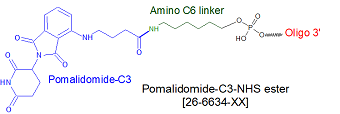
Modification : Pomalidomide-C3-NHS
Catalog Reference Number
Category
Modification Code
5 Prime
3 Prime
Internal
Molecular Weight (mw)
Extinction Coeficient (ec)
Technical Info (pdf)
Absorbance MAX
Emission MAX
Absorbance EC
26-6634
Affinity Ligands
[PDM-C3-N]
Y
N
N
317.32
-
PS26-6634.pdf
-
-
-
| Catalog No | Scale | Price | | 26-6634-05 | 50 nmol | $740.00 | | 26-6634-02 | 200 nmol | $740.00 | | 26-6634-01 | 1 umol | $885.00 | | 26-6634-03 | 2 umol | $1,265.00 | | 26-6634-06 | 5 umol | $1,886.00 | | 26-6634-10 | 10 umol | $2,828.00 | | 26-6634-15 | 15 umol | $3,390.00 |
Gene Link offers two versions of Pomalidomide modification. 1. Pomalidomide-C3-NHS is for oligo modified with an amino group and this version contains a C3 linker. 2. Pomalidomide-PEG1-C2-N3 is a an azide for click chemistry to DBCO or BCN. At Gene Link we use BCN to conjugate the azide version to oligos.
The use of a Pomalidomide modification represents a shift in how we approach targeted protein degradation (TPD).
Pomalidomide modification enables the creation of oligonucleotide-based PROteolysis Targeting Chimeras (Oligo-PROTACs) and aptamer-PROTAC conjugates. Pomalidomide acts as a highly effective recruitment ligand for the Cereblon (CRBN) E3 ubiquitin ligase, facilitating the ubiquitination and subsequent proteasomal degradation of target proteins. This modification is particularly valuable for engaging historically "undruggable" targets, such as transcription factors and RNA/DNA-binding proteins, by utilizing the programmable sequence recognition of the oligonucleotide.
By anchoring the pomalidomide payload to a targeting aptamer sequence, the degradation engine is effectively cloaked and selectively steered only to cells overexpressing tumor-specific surface biomarkers. This receptor-driven delivery logic ensures that the degrader remains inert until it internalizes into the target cancer cell, significantly boosting in vivo potency while sparing healthy tissues from unwanted side effects.
Tsujimura et al. (2023) utilized a 5' pomalidomide modification by linking this pomalidomide handle to a specialized DNA aptamer sequence targeting the estrogen receptor alpha (ERα). They engineered a bifunctional chimera capable of bringing the target protein and the cellular degradation machinery into close physical proximity. This targeted alignment successfully induces the selective ubiquitination and subsequent proteasomal destruction of the receptor, proving that pomalidomide-functionalized oligonucleotides can effectively expand the scope of targeted protein degradation to challenging intracellular targets.
References
- He, S., Dong, G., & Sheng, C. (2021). Aptamer-PROTAC Conjugates (APCs) for Tumor‐Specific Targeting in Breast Cancer. Angewandte Chemie International Edition, 60(43), 23299-23305.
- Watanabe, D., Terauchi, H., Osawa, H., & Demizu, Y. (2025). Phosphorothioate-modified DNA aptamer-based PROTACs for targeted degradation of estrogen receptor α. Bioconjugate Chemistry. Advance online publication.
- Tsujimura, H., Naganuma, M., Ohoka, N., Inoue, T., Naito, M., Tsuji, G., & Demizu, Y. (2023). Development of DNA aptamer-based PROTACs that degrade the estrogen receptor. ACS Medicinal Chemistry Letters, 14(6), 827-832.
- Pomalidomide-C3-NHS
|





 Oligo Purification