In this section: Introduction | Quality Control | Purification | Modifications | Long Oligos | Price List
In this section: Introduction | Molecular Beacon FAQ's | Fluorescent Probes Price List | Other Fluorescent Molecular Probes
In this section: SPCT | DME SPCT Intro | Order DME TaqMan® Assays SPCT | SNP PCT Search | Gene Expression Assays | SPCT Design Center | GeneAssays
In this section: RNA Oligonucleotides | Quality Control | Purification | Modifications | RNAi Explorer™ Products and Prices | Custom RNAi | RNAi Design Guidelines | SmartBase™ siRNA Modifications | shRNA Explorer™
In this section: PCR Amplification & Analysis
In this section: Introduction | Genemer™ | GeneProber™ | Prober™ Gene Detection Kits | GScan™ Gene Detection Kits | Genemer™ Control DNA | Infectious Diseases
In this section: Gene Construction
In this section: Introduction | The Omni-Clean™ System | The Omni-Pure™ Plasmid Purification System | The Omni-Pure™ Genomic DNA Purification System | Viral DNA & RNA Purification | Microbial DNA Purification | Plant DNA Purification
In this section: Introduction | Quality Control | Purification | Modifications | Long Oligos | Price List
In this section: Introduction | Molecular Beacon FAQ's | Fluorescent Probes Price List | Other Fluorescent Molecular Probes
In this section: SPCT | DME SPCT Intro | Order DME TaqMan® Assays SPCT | SNP PCT Search | Gene Expression Assays | SPCT Design Center | GeneAssays
In this section: RNA Oligonucleotides | Quality Control | Purification | Modifications | RNAi Explorer™ Products and Prices | Custom RNAi | RNAi Design Guidelines | SmartBase™ siRNA Modifications | shRNA Explorer™
In this section: PCR Amplification & Analysis
In this section: Introduction | Genemer™ | GeneProber™ | Prober™ Gene Detection Kits | GScan™ Gene Detection Kits | Genemer™ Control DNA | Infectious Diseases
In this section: Gene Construction
In this section: Introduction | The Omni-Clean™ System | The Omni-Pure™ Plasmid Purification System | The Omni-Pure™ Genomic DNA Purification System | Viral DNA & RNA Purification | Microbial DNA Purification | Plant DNA Purification
8-methyl-dG
8-methyl-dG
Code : [8-me-dG]
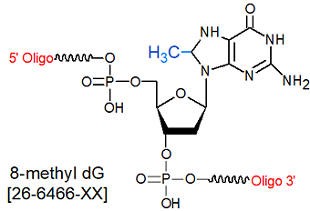
Modification : 8-methyl-dG
Catalog Reference Number
Category
Modification Code
5 Prime
3 Prime
Internal
Molecular Weight (mw)
Extinction Coeficient (ec)
Technical Info (pdf)
Absorbance MAX
Emission MAX
Absorbance EC
26-6466
Duplex Stability
[8-me-dG]
Y
Y
Y
343.21
7.4
PS26-6466.pdf
-
-
-
| Catalog No | Scale | Price | | 26-6466-05 | 50 nmol | $378.00 | | 26-6466-02 | 200 nmol | $378.00 | | 26-6466-01 | 1 umol | $420.00 | | 26-6466-03 | 2 umol | $588.00 | | 26-6466-06 | 5 umol | $1,015.00 | | 26-6466-10 | 10 umol | $1,972.00 | | 26-6466-15 | 15 umol | $2,156.00 |
| Discounts are available for 8-methyl-dG! |
| Modification* Discount Price Structure |
|
1 site/order
|
List price
|
|
2 sites/order
|
10% discount
|
|
3 sites/order
|
20% discount
|
|
4 sites/order
|
30% discount
|
|
5-9 sites/order
|
50% discount
|
|
10+ sites/order
|
60% discount
|
|
*Exceptions apply
|
The structural plasticity of DNA allows it to switch from its canonical right-handed B-form into non-canonical alternative arrangements such as left-handed Z-DNA and multi-stranded G-quadruplexes. Modifying specific bases within synthetic oligonucleotides is a powerful approach for rationally engineering and controlling these spatial shifts. 8-Methyl-2'-deoxyguanosine (8-Me-dG) is a crucial tool in this field. Replacing the hydrogen atom at the C8 position of guanine with a bulky methyl group introduces a sterile clash with the sugar ring. This structural constraint shifts the glycosidic torsion angle away from the anti conformation and locks the base into a preferred syn glycosidic conformation.
1. Z-DNA Conformation Stabilization and B-Z Transitions
Right-handed B-DNA requires nucleosides to adopt an anti conformation, whereas left-handed Z-DNA alternates between anti and syn orientations. Because 8-Me-dG is pre-organized into the syn conformation, its incorporation drastically reduces the energetic threshold needed for B-to-Z DNA transitions. [1, 2]
• Low Salt Transition: Unmodified oligonucleotides require unphysiologically high salt environments or chemical additives to form Z-DNA. Oligonucleotides synthesized with 8-Me-dG can form stable Z-DNA under physiological salt conditions, or even in the absence of salt. [1, 2, 3]
• Positional Dependency: Circular Dichroism (CD) studies have shown that position matters. Placing the modification toward the center of alternating purine-pyrimidine sequences maximizes Z-form stability. This application provides researchers with robust tools to evaluate the molecular pathways of Z-DNA-specific binding proteins like ADAR1. [1]
2. Rational Structural Tuning of G-Quadruplexes (G4)
G-quadruplexes are four-stranded nucleic acid structures formed by guanine-rich regions layered into G-tetrads. The overall topology of a quadruplex (parallel, antiparallel, or hybrid) relies strictly on the precise coordination of syn and anti orientations across its guanosine strands. [1, 2]
• Topology Stabilization: Substituting standard dG with 8-Me-dG at specific syn positions significantly stabilizes alternative topologies. For example, in the Thrombin Binding Aptamer (TBA), targeted replacement improves structural stability and enhances thrombin inhibitory activity
Accelerating Quadruplex Assembly: Incorporating 8-Me-dG at the 5'-end of tetramolecular parallel G-quadruplex sequences accelerates folding kinetics by 15-fold or more. This rapid assembly happens because the modification correctly pre-aligns the required syn conformations, which minimizes entropic penalties during structural initiation.
3. Enhancement of Aptamers and Nucleic Acid Therapeutics.
For therapeutic oligonucleotides like Antisense Oligonucleotides (ASOs), siRNAs, and aptamers to remain active in vivo, they must resist biochemical breakdown. [1]
• Nuclease Resistance: The bulky C8-methyl group physically shelters the adjacent phosphodiester backbone from cellular nucleases without disrupting essential Watson-Crick pairing capabilities. This modification enhances metabolic stability and prolongs serum half-life.
• Conformational Control: By pre-arranging active configurations, 8-Me-dG aids in developing highly target-specific aptamers that remain rigid and bound to target proteins under physiological conditions. [1, 2]
4. Probing Biomarker Damage and Repair Pathways
Endogenous cellular stress and environmental alkylating toxins naturally modify purines at the C8 position. [1]
• Synthetic Lesion Model: Oligonucleotides synthesized with 8-Me-dG act as defined controls to simulate structural cellular damage. This allows researchers to track how error-prone DNA polymerases bypass lesions during replication, as well as how base excision repair (BER) systems identify and replace damaged nucleotides.
References
1. Effects of 8-methylguanine on structure, stability and kinetics of tetramolecular parallel G-quadruplexes. Biochimie, 93(3), 445-460.
2. 8-Methyl-2′-deoxyguanosine incorporation into parallel DNA quadruplexes. Nucleic Acids Research, 33(20), 6530–6538.
3. Investigation of B-Z transitions with DNA oligonucleotides containing 8-methylguanine. Nucleic Acids Research Symposium Series, 58(1), 103–104.
4. 8-Methylguanosine: A Powerful Z-DNA Stabilizer. Journal of the American Chemical Society, 125(44), 13322–13323.
5. Z-DNA under physiological salt conditions: Structure and thermodynamic properties of d(CGC[m8G]CG)2. Nucleic Acids Research, 31(9), 2325–2333.
6. Late-stage guanine C8–H alkylation of nucleosides and oligonucleotides. Nature Communications, 15, 2341.
7. Structural Probes in Quadruplex Nucleic Acid Structure Determination. Molecules, 17(11), 13073-13101
- 8-methyl-dG
|
|





 Oligo Purification